Draft for review · not published
SEO
How Does ChatGPT Decide Which Companies to Recommend?
A plain-English explanation of how ChatGPT and other AI assistants choose which businesses to name in answers, and what that means for your website, reputation and content.
By Emma Frewin
When someone asks ChatGPT to recommend a supplier, the assistant returns a handful of names with a reason for each. Businesses understandably want to know how that list is chosen. OpenAI does not publish a ranking formula, but we can explain the mechanics that are known and the signals that consistently matter.
The short answer
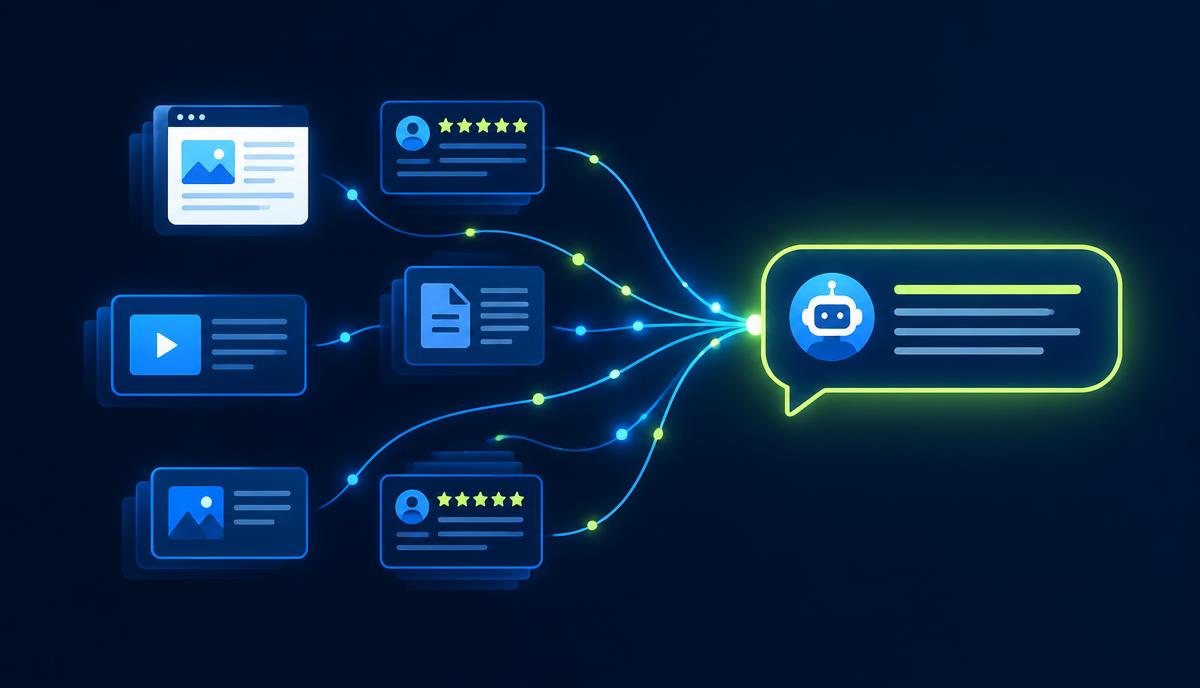
ChatGPT combines what the model learned during training with information retrieved from the web at the time of the question. It then writes an answer that fits the user’s request. Businesses are named when the available sources describe them clearly, consistently and credibly in relation to that request.
Two sources of knowledge
Training data
Large language models learn patterns from very large collections of text. Well-established businesses that have been written about widely are more likely to be “known” to the model, although this knowledge can be out of date.
Live retrieval
For many questions, particularly those about products, services or recent information, ChatGPT searches the web and cites the pages it uses. OpenAI's crawler documentation describes OAI-SearchBot as the crawler used to surface websites in ChatGPT search. If your site cannot be crawled, it is less likely to be retrieved and cited.
What influences which businesses are named
Relevance to the exact question
Prompts often include qualifiers such as sector, location, company size or budget. Pages that explicitly address those qualifiers are easier to match. A page titled “B2B PPC management for UK manufacturers” is more relevant to that question than a generic “Our services” page.
Clarity of the entity
The system needs to understand that your business is a distinct organisation with specific services. Consistent naming, a clear About page, structured data and matching details across profiles all help.
Independent corroboration
Mentions in trade media, comparison articles, directories, partner listings and review platforms give the assistant external evidence. When several sources agree, the description is easier to repeat.
Evidence and specifics
Named case studies, measured results, accreditations and detailed product information give the model something concrete to say. Answers often echo phrases from these sources.
Freshness
For time-sensitive questions, recently updated pages and recent coverage are more likely to be retrieved.
What does not work
- Keyword stuffing. Repeating phrases does not make a business more credible to a system that summarises meaning.
- Self-published superlatives. Claims such as “the UK’s best agency” carry little weight without independent support.
- Mass low-quality content. Large volumes of thin pages dilute your positioning and can damage trust in search generally.
- Hidden or misleading text. Attempts to manipulate AI systems risk exclusion and reputational harm.
How Google’s AI features compare
Google’s AI Overviews and AI Mode draw on Google’s search index and ranking systems. Google Search Central guidance on AI features states that there are no additional requirements beyond standard SEO best practice to appear in these features. Strong organic SEO therefore remains the foundation for AI visibility in Google. Our SEO services and AI SEO services pages explain how we approach both.
What this means for your business
- Make every core service or product understandable in one sentence, on its own page.
- Ensure AI and search crawlers can reach and read your content.
- Publish verifiable proof: case studies, results, credentials and reviews.
- Earn coverage from the independent sources that already appear in answers for your market.
- Monitor a fixed set of prompts over time.
For product-led businesses, see How to get your products recommended by ChatGPT and AI search.
Key takeaways
- ChatGPT blends model knowledge with live web retrieval and cites its sources.
- Relevance, clarity, corroboration and evidence determine which businesses are named.
- Shortcuts and manipulation do not build lasting visibility.
- Good SEO remains the foundation, especially for Google’s AI features.
Frequently asked questions
Does ChatGPT use Google results?
OpenAI has not published a full list of the search providers and indexes ChatGPT search uses. It runs its own crawler, OAI-SearchBot, and cites the web pages it uses in answers. The safest approach is to be accessible and well represented across the open web rather than relying on any single source.
Do reviews affect AI recommendations?
Reviews on reputable platforms are one of the sources assistants can draw on when describing businesses, particularly for local and consumer services. Consistent, genuine reviews help the system describe your strengths with confidence.
Why do answers change each time I ask?
Generative models produce answers probabilistically and may search the web differently each time. Wording, location, conversation history and personalisation settings can all change the result, so look for patterns across many prompts.
Want to know how AI assistants currently describe your business? If you would like an honest view of where you stand, talk to our team or read more about our AI SEO services.
Sources: OpenAI's crawler documentation; Google Search Central guidance on AI features.
More from blog
SEO
How to Manage Negative Reddit Posts About Your Brand Without Making Things Worse
Negative Reddit posts can rank in Google and shape AI answers. Learn when to respond, ignore or report, what Reddit allows, and how to protect your brand.
Emma Frewin · 1 October 2026
SEO
AI Search and SEO: How to Optimise Your Content for the Future of Search
Learn how AI-powered search is changing SEO, what still matters, and how to create content that gets found across Google and AI search platforms.
Chloe Leagas · 15 July 2026
SEO
What Is Search Intent and Why Is It Important?
Discover what search intent means, the four main intent types, and how matching content to user intent improves SEO and conversions.
Chloe Leagas · 18 May 2026
Next step
Want this applied to your own marketing?
- Google Premier Partner
- Microsoft Advertising Partner
- Since 2002 · 300+ clients